Showing posts with label John Wayne. Show all posts

Wednesday, August 11, 2021

The Range Feud (1931)

 A tale of two young lovers amidst a tale of range war, cattle rustling and double crosses, this early 30's western features appearances by a who's who of B Westerns of the day. Headlined of course by the legendary Buck Jones as a sheriff trying to keep the peace, John Wayne as his younger adopted brother, Harry Woods as an excellent sleazeball and perennial bad guy Glenn Strange in an uncredited role.
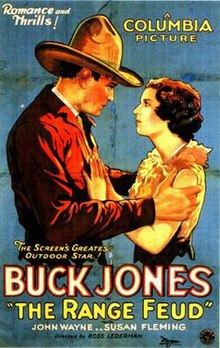


A slight western that only works on the strength of Buck Jones' presence, with a young John Wayne in a supporting weaker role as a love struck suitor who is incapable of taking care of himself, constantly requiring Buck to get him out of whatever mess. 

The basic story involves the titular range feud between two families, cattle rustling, and frame ups that land Duke in jail, where he languishes until a lynching party drags him helplessly to be hung. BUT WAIT! Buck rides in at the last minute and reveals that the slimy Woods is the culprit and all is well in the end.  

This definitely more of movie for fans of the legendary Buck Jones than for fans of the Duke. As a John Wayne movie it's extremely disappointing, but taken at face value as a Buck Jones movie it's a fun ride.

Aside from that quibble, this is well produced B western that I definitely recommend for fans of the genre or lead actor. 


This was one of the pictures Duke made as he tumbled down into poverty row stardom after the failure of his debut lead role The Big Trail (1930), which had nothing to do with him at all, but still tainted him as poison for nearly a decade. 

The other thing that derailed his career at this stage was the tyrannical Harry Cohn who falsely believed that Duke was sleeping with a starlet that Cohn himself had designs on. He kept putting Duke lower and smalls and played out his contract upon which time he spread rumors that Duke was a heavy drinker and frequently showed up drunk on sets. 

Duke never forgave Cohn for this and swore he would never make another picture for Columbia.. And he never did. Even when he became the biggest star in Hollywood and Cohn came crawling back with all sorts of enticements and tried desperately to get Duke to make a movie for his studio. 

Buck Jones remained fairly popular for the rest of his career despite his descent into lower quality pictures over the next decade. 

He made a handful of successful serials and eventually rode off into that western sunset with the Rough Riders series which teamed him up with the equally legendary Tim McCoy, with Raymond Hatton as the comedy relief partner. 

It's unknown how much longer his career would've lasted had he not died tragically as a result of club fire in the early 40's. Popular legend says he perished a hero to the last, trying desperately to save others in the fire. In the end though he was just one of the 492 victims of the Cocoanut Grove fire in Boston, MA. He passed away in the hospital Nov 30, 1942. 2 days after the fire. He was 50 years old.

Monday, August 2, 2021

The Big Trail (1930)

John Wayne takes the lead in this very early widescreen western that depicts the westward expansion as a Wagon Train travels The oregon trail. Filmed on location with practical effects and no CGI trickery, this is as close to witnessing the trek in person.
Playing Breck Coleman, Duke is on the trail of the scoundrels that killed his mentor and stole his wolf pelts along the way he joins a wagon train and extracts vengeance on a trio of scooundrels. He winds up winning the girl and triumphing over the villains. One of whom, Red Flack, is played to the hilt by Tyrone Power. Sr (Father of Tyrone "Zorro" Power. Jr) coming across as a living cartoon and appears to be searching for Popeye and Olive Oyl. He's basically Bluto from Popeye.
The second badguy is the romantic rival Bill Thorpe, played rather stiffly and stagebound by Ian Keith. Who John Wayne would evenually doube as the dead body for in a later picture. 

The third is a rather forgettable hispanic character, Lopez, played by Charles Stevens who plays him as a stereotypical bandito type. 

The movie is at heart a survival film as Coleman tries outwit, outlast, survive the machinations and schemes of this dastardly trio all the while trying to win the heart of Ruth, while guiding settlers through treacherous territory and keeping them alive. 

 The plot is rather thin and instead focuses on the interplay between the characters with a heavy focus on three particular groups, the rivalry between between Coleman and Thorpe for the heart of Ruth: The dastardly trio of of Thorpe, Lopez, and Flack, and lastly Coleman's friendship with Tully Marshall as Zeke.
There are also two comedic side characters played with varying effectiveness by Russ Powell as Windy, the master of animal sound effects, and the very tiresome antics of El Brendal as a Swedish immigrant with an overbearing mother-in-law. His scenes are not very well developed and drag things down. 

 Another issue with the movie are the three wildly different acting methods on display, you have Silent style, Stage style, and the just developing Talkie Style. They really don't mesh well, with the three styles best being exhibited by Power Sr. (Silent), Kieth (Stage) and Marshall (Talkie). 

Marguerite Churchill as Ruth Cameron is firmly in the stage camp and doesn't really have a spark with Duke who is trying his best to do the Transatlantic accent foisted upon him by the studio and an overbearing dialect coach. He also wavers between the stage and talkie styles coming across uncertain at times of what is being expected of him.  Nonetheless, he comes off as the best along with, Tully Marshall, of the bunch as he slowly seems to get a grasp on an early form of his screen persona. 

The Big Trail is a fascinating peek at the development of a screen icon that would continue to grace the screen for over 45 more years. And considering that he was ill with dysentery and lost 20 lbs during filming, he does a fantastic job. 

 Other interesting points (Which I am copying from the Wikipedia Page

Ward Bond has a few scenes in this movie and even a line of dialogue or two. One of his earliest movies in support of Duke who he would last work with on Rio Bravo (1959) For the film, 

Walsh had employed 93 actors and used as many as 725 natives from five different Indian tribes. He also obtained 185 wagons, 1,800 cows, 1,400 horses, 500 buffalos and 700 chickens, pigs and dogs for the production of the film. 

Filming on The Big Trail began on-location just outside Santa Fe, New Mexico in April 1930, which was unheard of at the time  

The film was shot in an early widescreen process called 70 mm Grandeur film, which was first used in the film Fox Movietone Follies of 1929, The Big Trail was the last time it was used. Grandeur proved financially unviable for an industry still investing in the switch to talking pictures It would be over 20 years after the release of The Big Trail before the concept of widescreen films was revived; the same Grandeur lenses were eventually used for The Robe. 

Beyond the format difference, the 70mm and 35mm versions vary substantially from each other. They were shot by different cameras, and footage for each format was edited separately in the cutting room. Some scenes were shot simultaneously by both cameras, the only difference being the angle (with the better angle usually given to the 70mm camera). Some scenes were shot first by one camera, and then retaken with the other camera. The 70mm cameras could not focus well up close, so their shots were mainly panoramas with very few close-ups. The 35mm cameras could move in and focus at short distances. Thus, scenes in the 70mm version might show two characters talking to each other in the same take, making greater use of the widescreen frame, while the 35mm version would have close-up shots cutting back and forth between the two characters. This may have been an artistic choice as much as a technical one. 

 A fairly common practice in the early sound era was to simultaneously produce at least one foreign-language version of a film for release in non-English-speaking countries; an approach later replaced by simply dubbing the dialogue. There were at least four foreign-language versions made of The Big Trail, all filmed in 35mm, 1.20:1 ratio and using different casts and different character names:  

My rating 6/10. An interesting experiment and peek at epic filmmaking before the advent of CGI this is always worth a look to see a young Duke learning his trade and the beautiful location cinematography